
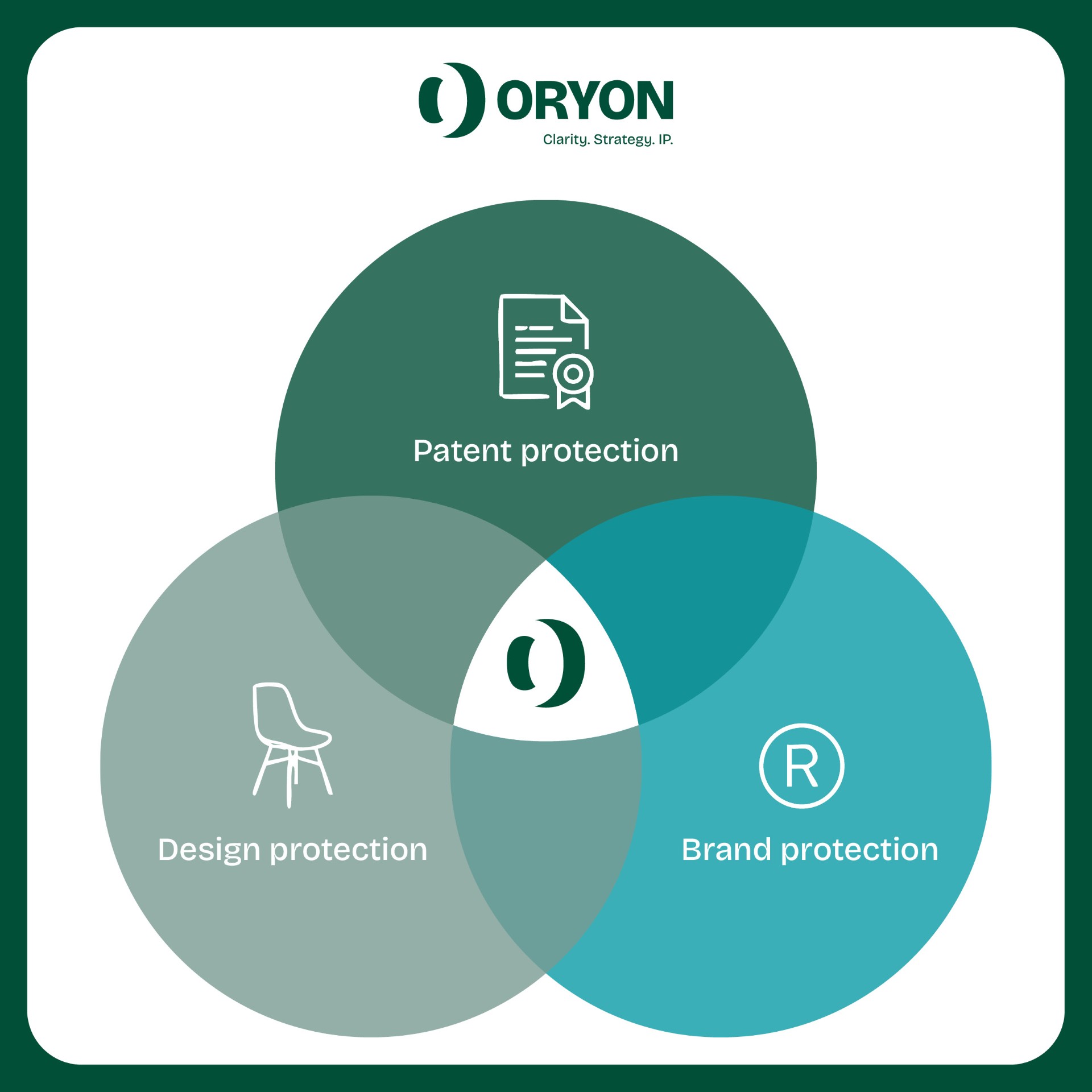
Quite a few companies register their trademark and assume that they are protected. Or they file a patent application and consider the case settled. Until they face an infringement or find themselves in a legal conflict. Only then do they realize that winning a case in intellectual property (IP) requires building a solid fortress around your assets, layer by layer.
Owners of strong brands think strategically: they don’t rely on just one of the various intellectual property rights, but combine them so that when one layer of protection fails, the next one holds.
The IP trifecta: combine 3 or more forms of protection
IP-trifecta is a legal strategy in intellectual property law (IP). It refers to the simultaneous use of three forms of protection to optimally protect a product against counterfeiting and infringement. By making smart use of the fourth form of protection ‘copyright’ in addition to patents, design rights and trademark rights, you go one step further.
- Patent: protects how your product works (technology and functionality)
- Design right: protects how your product looks (shape, lines and appearance)
- Trademark law: protects your name, logo and brand identity
- Copyright: protects creative expressions in content and design and is automatically created
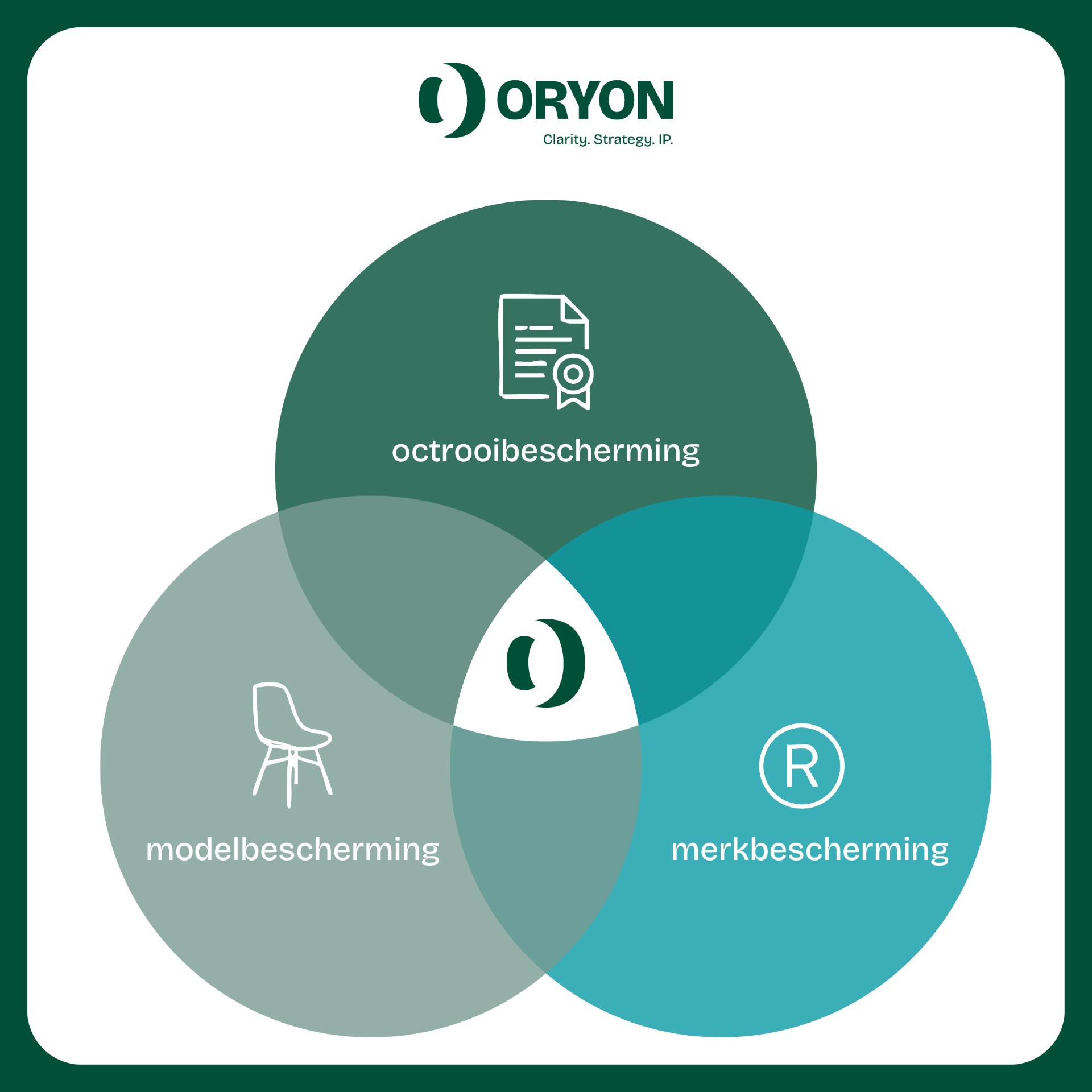
Fill the gaps of one IP with another IP
Every intellectual property right fills the gaps that other rights may leave open. A patent expires after 20 years, after which your technical invention is free to use. Moreover, a competitor can build an alternative around it during that protected period. But a registered design, a protected trademark appearance and copyright that act together with your patent? They form a much stronger wall that is difficult to break.
Dyson: A successful example of IP trifecta
There are several brands and companies that successfully apply this approach. One of them is Dyson, which develops cordless vacuum cleaners and other household appliances. The brand plays on its innovative character by communicating consistently about “Dyson technology”.
To protect its market position, Dyson combines patents (around cyclonic separation technology), design rights (the recognizable design of their products) and trademarks (the Dyson brand and derivatives). This provides a total protection that analysts nowadays call a real “fortress”.
When competitors like Hoover, Vax, and Samsung brought similar products to market, Dyson had multiple legal weapons to act. In 2024, the company even obtained a preliminary injunction against SharkNinja through the new Unified Patent Court (UPC) in Munich. This layered IP approach allowed Dyson to pursue enforcement across the entire European Union in one move.
The combination is stronger than the sum of its parts
Each intellectual property right protects a different dimension of your product. Together, they create overlapping layers of protection so that no circumvention strategy can undermine the entire protection.
For companies operating in Europe or the Benelux, all instruments are available: European patents via the EPO, EU-wide trademarks and designs via the EUIPO, and Benelux registrations via the BOIP. Copyright arises automatically from the moment of creation, but must be actively used by the owner.
The mistake many companies make is that they treat these rights as separate decisions, under the responsibility of different teams. However, the power of IP trifecta only comes into its own when we plan everything strategically, ideally before the product launch and of course not after a competitor has already made a copy.
Three interesting questions to ask
- Do you have a patent that protects how your product works, but no registered design protecting its appearance?
- Is your trademark registered in the right classes and in all the markets in which you operate?
- Have you documented the creative elements (packaging, user interface, content, etc.) sufficiently so that you can effectively enforce your copyright ?
If you have to answer “no” or “I don’t know” to any of these questions, that’s the weak spot your competitor can use to attack your fortress.
Think ahead, with a comprehensive IP strategy
Are you convinced that you need a layered approach to secure your market position? At Oryon, we are happy to think along with you about a total IP strategy.